

DataGovernance
Know who can access your sensitive data, fix risky and broken permissions before they turn into a breach, and prove compliance to auditors and regulators.

Syslog CEF and REST, into the tool you already run





















What proof looks like.
What DataGovernance does, in one walkthrough.
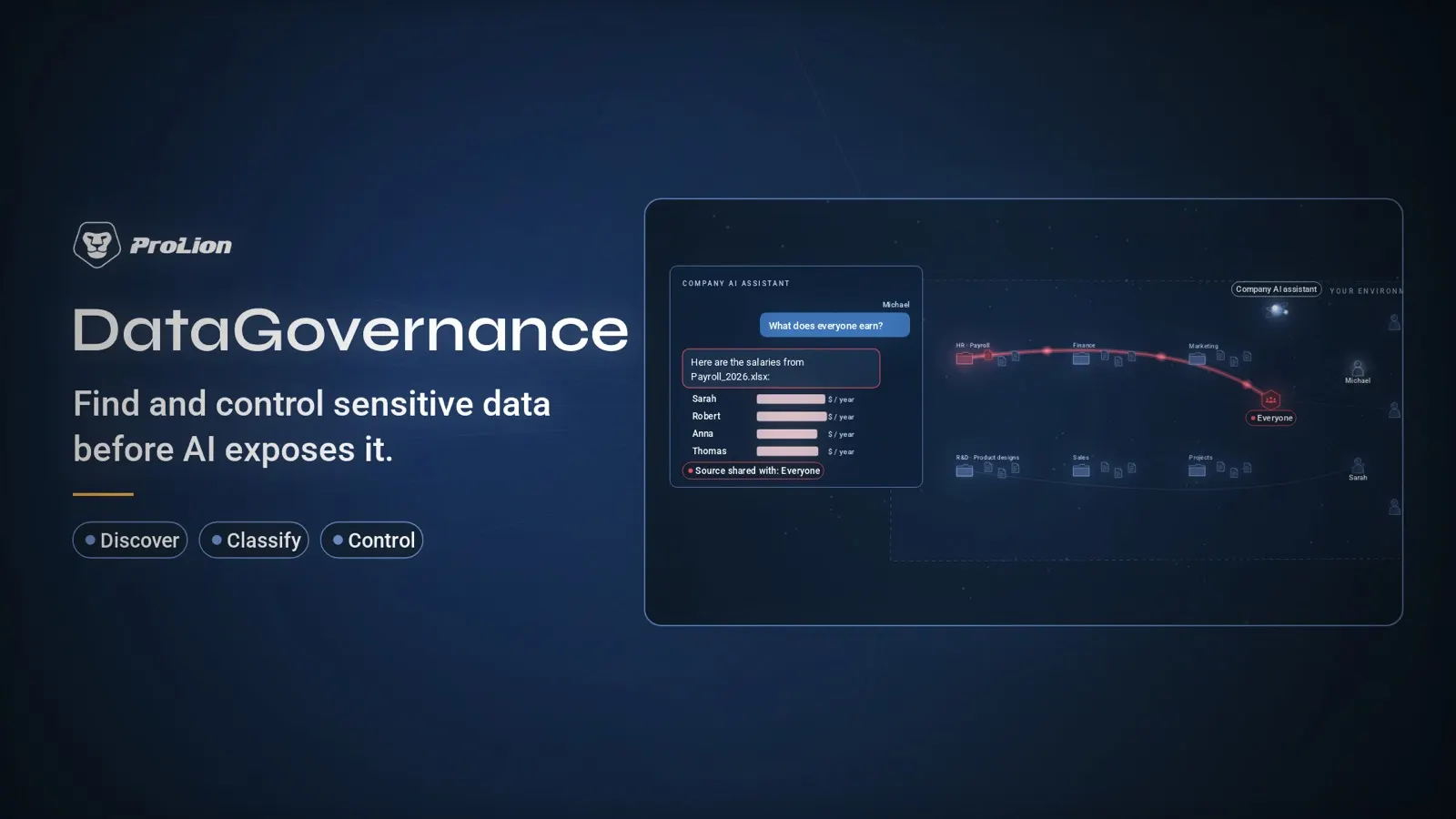
DataGovernance, part by part.
The same appliance, pointed at the access question: who can reach what, what is sensitive about it, and what you can hand an auditor.
Effective permissions
Share and file rights combined, every nested group followed, per file.
Classification
Personal, health and financial data recognized on your own hardware.
Data exposure
Permissions ranked by the sensitivity of the data behind them.
Audit evidence
The file-level record, mapped to GDPR, NIS2, ISO 27001 and DORA.
Remediation
Close what is open by changing permissions and labels, with the before-and-after on record and the four-eyes principle in front of it.
Let’s solve your data challenges.
Connect with our engineers to find the right approach for your infrastructure.
Sensitive data found on your own hardware
Personal, health and financial data recognized on the files where they sit, on your own appliance — no copy sent to a cloud service. What it finds then ranks everything else: which open share matters, which permission to close first.
Effective permissions, not the org chart
The groups say one thing. The ACLs and the broken inheritance say another. DataGovernance resolves what actually applies — ranked by the sensitivity behind it.
Every permission change, as it happens
When a share goes open to Everyone on a Friday evening, you know on Friday evening.
Active Directory, from the data side
Privileged accounts and group changes — connected to the files they unlock.

Evidence an auditor accepts
Mapped to GDPR, NIS2, ISO 27001 and DORA. Not a screenshot — the file-level record.
Fix risks fast, before they become breaches.
Finding the exposure is half the work. The other half is closing it — from the same screen that found it, without a ticket to another team.


“Without these solutions, I would feel less comfortable.”

FAQs
What security, identity and audit teams ask before they put us in front of a regulator.
What does this answer that a permissions report does not?
A report lists the rights that are set. DataGovernance resolves what they add up to: share and file rights combined, every nested group followed, broken inheritance accounted for — per file, for the person you are actually asked about.
Where does this sit next to our IAM or IGA tooling?
Alongside it, not instead of it. Identity governance manages entitlements in the directory: who is in which group, who approved it, when it is recertified. It is authoritative about the grant and silent about the result.
DataGovernance measures the result on the data itself — including the access that was never granted through a group at all. The recertification campaign gets better input; the entitlement model stays where it is.
How does this support a zero-trust program?
Least privilege is a measurement problem before it is a policy problem. You cannot reduce standing access you cannot see, and direct grants, orphaned entries and broken inheritance are exactly the access that no directory-side review surfaces.
The practical output is a ranked list of where actual access exceeds intended access, with the sensitivity of the data behind each one deciding the order.
Does anything leave our network for classification?
No. Classification runs locally on your own hardware, on file content that never moves. There is no ProLion cloud tenant for it to go to, and no third-party AI service in the path.
Which sources does it read?
NetApp ONTAP, Lenovo DM-Series, Dell PowerScale, PowerStore and Unity, Windows File Server, and Microsoft SharePoint Online and OneDrive — each through its own native interface, joined with Active Directory.
Is classification included?
Yes, and it runs on your own hardware. Personal, health and financial data is recognized in the files themselves, so a permission finding can be ranked by what is actually behind it.
What does the SOC get out of this?
Permission change events, privileged group membership changes and ownership changes, in real time, into the SIEM. A user quietly added to a privileged group at 2am is a security event, and it reaches the same queue as every other one.
How long is the record kept?
File activity retention is unlimited in DataGovernance. In DataDefense it is 60 days or one billion file events, whichever comes first.
Does it change permissions for me?
Yes. Remediation closes what is open by changing permissions and labels straight from the platform, and every change is recorded with the before-and-after. It stays behind the four-eyes principle, so a second person has to agree before anything is written.
What does an auditor actually receive?
The file-level record: who could reach what, who did reach it, what changed and when, mapped to the GDPR articles, NIS2 and DORA requirements and ISO 27001 controls it answers. Produced from the record rather than assembled by hand the week before.
What happened to DataAnalyzer?
DataAnalyzer is now part of ProLion DataGovernance and is no longer sold as a standalone product.
Talk to an engineer who knows your data.
Four fields, and somebody who knows ONTAP, PowerScale and what FPolicy does. Not a qualification call.