

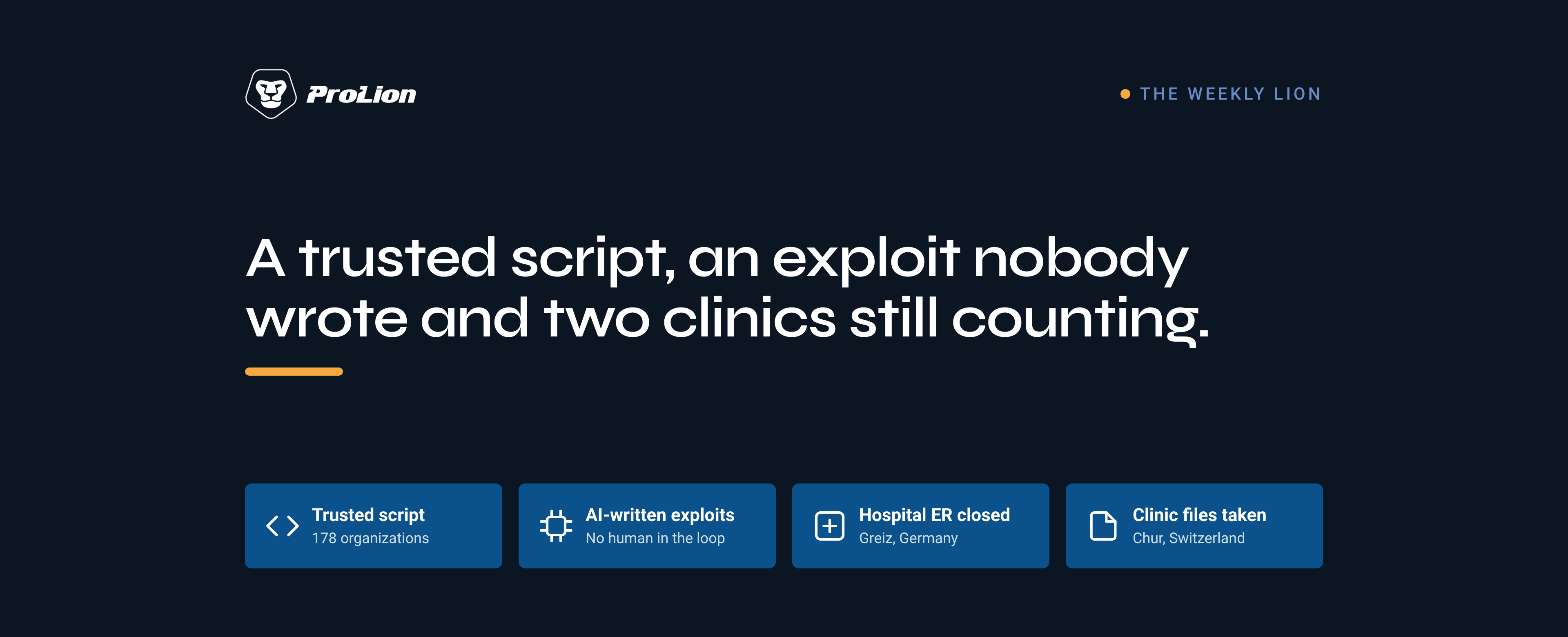
On November 16, 178 organizations served malware to their own website visitors. None of them had been breached. The code came from a tool they trusted, loaded from that tool’s own servers.
Welcome to the second Weekly Lion. Last week’s theme was that the organization owning the data was the last to know what happened to it. This week adds a second problem: attackers are getting faster, and they increasingly arrive through something you already trust.
A vendor’s script. An AI agent that turns a fresh patch into a working exploit with no human at the keyboard. And two healthcare providers in the DACH region that, weeks or days after an attack, still cannot say exactly what was taken.
1. Global: 178 organizations served malware through a tool they trusted
On November 16, an attacker exploited a vulnerability in Optimizely’s web experimentation platform and planted malicious JavaScript in customer projects. Optimizely confirmed the incident, fixed the flaw and removed the injected code.
- Who was affected: Researchers counted 178 organizations, including Zoom, the BBC, CNN, Salesforce, GitLab, IKEA, HSBC, Equifax and Air France-KLM. Banks and financial firms were the largest group, with 32 organizations.
- What the code did: It swapped cryptocurrency wallet addresses, skimmed payment cards typed into sites’ own forms, stole cookies and screenshots, and tried to deliver iOS exploit kits to iPhones and iPads.
- Why it worked: The code loaded from Optimizely’s own content delivery network, so browsers treated it as trusted. Of the affected organizations, only 24 had a Content Security Policy strict enough to block it.
- It was not alone: Other researchers traced poisoned scripts to three more services, with the earliest tampered responses on November 13.
Why it matters: A website can be compromised through a third-party dependency without its own code or infrastructure ever being breached. Every organization runs code and holds data it did not write and does not fully control. Trust given once is not trust verified every day.
2. Global: An AI agent that writes and launches exploits on its own
On November 17, Google Threat Intelligence Group (GTIG) and Mandiant reported that threat actors are letting AI agents run whole stages of live intrusions. For the first time, GTIG says, it saw vulnerability discovery and exploitation automated with no human in the loop.
- What they found: An exposed staging server hosted a multi-agent framework called exploit_agent. It compares web application code before and after a patch is announced, finds the flaw, drafts an exploit and runs it. The server also held data stolen from victims.
- Who is using these tools: Financially motivated groups and suspected China-nexus espionage actors are running open source agentic pentesting frameworks against real targets. The FBI issued a FLASH alert on November 13 about one of them, ARTEX, used since at least August against financial services, government, healthcare, energy and other sectors.
- The pace: GTIG’s earlier analysis found that disclosures and exploits nearly doubled between January and August 2026. Zero-day exploits reached 22 in August, against a 2025 average of 8 a month.
- The good news, for now: These frameworks trade stealth for speed and leave traffic and code traces that make them easier to catch.
Why it matters: The gap between a patch and an attack used to be measured in weeks. Once a machine can read the patch and write the exploit, that gap is set by compute, not by people. The intrusion techniques are familiar, stolen credentials and unpatched systems, but they now run at machine speed. Machine-speed attacks need detection that does not wait for a human to notice.
3. Germany: A hospital emergency room closed by extortion
On the evening of November 14, systems began failing at Kreiskrankenhaus Greiz-Ronneburg in Thuringia, a 256-bed district hospital. By 9 a.m. on November 15 it was clear the hospital had been attacked, and an extortion message arrived the same day.
- The impact: Because attackers had reached several computer systems, the emergency room in Greiz stopped taking patients for about two days. Emergencies were routed through the control center in Gera to other hospitals.
- Where it stands: The emergency room reopened step by step on the evening of November 16. Medical devices work, but data connections and digital treatment plans were still disrupted.
- What is not known: The hospital and the district have not said how much the attackers demanded or whether patient data left the building. The State Criminal Police Office and prosecutors are investigating, and police say they are pursuing a suspect.
Why it matters: For a hospital, ransomware is not an IT outage. It is an ambulance taking a longer route. And once services are back, the harder question remains: was patient data taken? Under GDPR and NIS2, that answer is not optional, and it has a deadline.
4. Switzerland: X-rays and prescriptions gone from local storage
Medical center Gleis D and the Medi Porta pharmacy in Chur confirmed that attackers took names, addresses, prescriptions, X-ray images and employee data. The attack happened on October 12, according to the chairman of the board. The center made it public on November 2, and Swiss media reported on it through mid-November.
- What was hit: Local storage locations. The electronic patient record runs in a separate application and, according to the center, was not affected.
- What the attackers claim: A group called Cloak says it took 87 gigabytes, including identity documents and financial records. This is not independently confirmed.
- What is still open: How many people are affected. The center says this is still being evaluated. It reported the incident to the Swiss Federal Office for Cyber Security and the Federal Data Protection Commissioner and filed a criminal complaint.
- How patients find out: Not by letter. The center informs through its website and press release and notes that people can be affected without a personal notice.
Why it matters: The core clinical system was safe. The files around it were not. Scans, prescriptions and documents on file shares are often the least watched data in an organization, and more than a month after the attack, nobody could yet say whose data left.
Also on our radar
- Latvia: airBaltic disclosed on November 15 that unauthorized parties accessed about 618,000 booking records held by an external IT provider. The airline says its own systems were not affected. Names, booking numbers and flight details were visible; payment data and travel documents were not. Latvia’s data protection authority has opened a review.
- US: The FBI’s November 13 FLASH alert on the ARTEX agentic pentesting framework is worth passing to your SOC. It names financial services, government, healthcare and energy among the targeted sectors.
- Germany: The Greiz attack came as Thuringia’s interior minister presented the state’s annual intelligence report, saying hybrid threats have become everyday business.
The common thread
Put the four side by side. A trusted vendor’s script turned hostile overnight. An AI agent turned patches into exploits without anyone at the keyboard. A hospital got its emergency room back in two days but still has not said whether patient data left. A medical center knows its files were taken but, weeks later, not whose.
Attackers now move at machine speed and often through something you already trust. Defenders still answer the most important question, what did they touch, in weeks.
That gap is the risk. It closes only when you have your own record of what is being read, how much, how fast and by which identity, kept at the data itself.
Where ProLion fits
Our mission is to help the world’s most regulated organizations know, protect and control their data, wherever it lives, so they can move confidently into the AI era.
ProLion runs fully on-premises, including in air-gapped environments, and connects without agents by streaming data events. It sees every read, write and copy against your file data as it happens. Against this week’s news:
- Discover: Find where patient files, scans and other regulated data actually live on your file shares, including the local storage that sits outside your core systems.
- Classify: Tag health, personal and financial data on your own hardware, so you know which shares matter most before an attacker does.
- Access: Show which identities can reach that data and cut the broad access that lets one stolen account read everything.
- Monitor: Keep a record of every file operation, so “whose data left?” has an answer in minutes, not weeks.
- Detect: Flag bulk reads, machine-speed access and ransomware behavior as they start, which is exactly what automated attack frameworks produce.
- Respond: Block the offending identity automatically and restore affected files from snapshot, while the business keeps running.
That record is also what regulators ask for, under NIS2, DORA and GDPR in Europe and their equivalents elsewhere.
To be clear about scope: ProLion would not have stopped malicious JavaScript in a website visitor’s browser, and it does not patch web applications. What it gives you is the part every organization in this week’s healthcare stories needed most: your own evidence, on your own systems, of what happened to your data.
What to do this week
Five steps for CISOs and data owners:
- List the third-party code and services that touch your data or your customers. Then ask which of them could change what they deliver to you without you noticing.
- Check your Content Security Policy. Allowing a vendor’s domain is not protection if the attack comes from that domain.
- Find the files outside your core systems. Scans, exports, prescriptions and reports on file shares are regulated data too.
- Patch internet-facing applications faster. The exploit may already be written. Make sure detection on your data does not depend on someone being awake.
- Run the Greiz test. Ask your team: if we were hit tonight, how long until we can say whether patient or customer data left? If the answer is weeks, that is the gap to close.
The bottom line
Trust is still necessary. Vendors, scripts and AI tools are how modern organizations work. But trust has to be backed by evidence, and the evidence that matters most sits at the data itself. When attacks move at machine speed, “we’re still investigating” is not an answer regulators, patients or boards will wait for.
If you want to see how fast your own data could answer “what did they touch?”, talk to our team and we’ll walk you through it on your own environment.
See you next week.
Sources
- Malware spread through Optimizely hits 178 organizations, including BBC, CNN and Zoom, Help Net Security, November 17, 2026
- Optimizely confirms massive cyberattack on customer websites injected stealer malware, CSO Online, November 17, 2026
- Google finds AI agent writing and launching exploits with no human in the loop, Help Net Security, November 17, 2026
- Krankenhaus Greiz: Erpressung bestätigt, Notaufnahme öffnet, derimeter, November 17, 2026
- Cyberangriff auf Kreiskrankenhaus Greiz-Ronneburg, Borns IT- und Windows-Blog, November 16, 2026
- Cyberangriff auf Gleis D Chur: Röntgenbilder abgeflossen, derimeter, November 16, 2026
- airBaltic: Unbefugter Zugriff auf 618.000 Buchungen, derimeter, November 17, 2026