

Two million prompts, three breaches
When you send a prompt to an AI service, you are trusting a supply chain you have probably never seen. New research shows how fragile that trust is.
This week, Dragos Chief Research Officer HD Moore published the results of a five-month experiment (Dragos). From July through November 2026, his team sent about two million prompts to widely used AI services. Each prompt carried unique, trackable secrets: URLs, passwords and live AWS keys tied to empty, fully logged accounts. Then they watched where those secrets showed up.
The findings should concern every regulated organization using AI:
- Three AI hosting providers were breached. Attackers copied requests, including real customer prompts, and none of the three providers knew until Dragos told them. The earliest breach dates back to mid-July.
- Stolen credentials were used within hours. Attackers tested the planted AWS keys, searched storage and secrets vaults, and tried to create their own users to keep access. The bait keys drew tens of thousands of AWS API calls.
- Resellers read customer prompts. On AI inference marketplaces, some sellers simply listed a model at the lowest price, turned on logging and harvested the requests. No exploit was needed.
- Privacy settings were ignored. Prompts marked "Zero Data Retention" were stored, shared and read. Prompts sent to U.S.-based providers flowed to a Chinese AI lab, and one secret link surfaced in a company chat in China 24 days later.
Your prompts carry your crown jewels
The real lesson is not about any one provider. It is that once data leaves your environment inside a prompt, you lose control of where it goes.
Prompts are rarely just questions. Employees and AI agents paste in source code, contracts, patient records, financial models, customer data and, too often, passwords and keys. As Dragos points out, the inference data itself is often worth more than the compute used to process it.
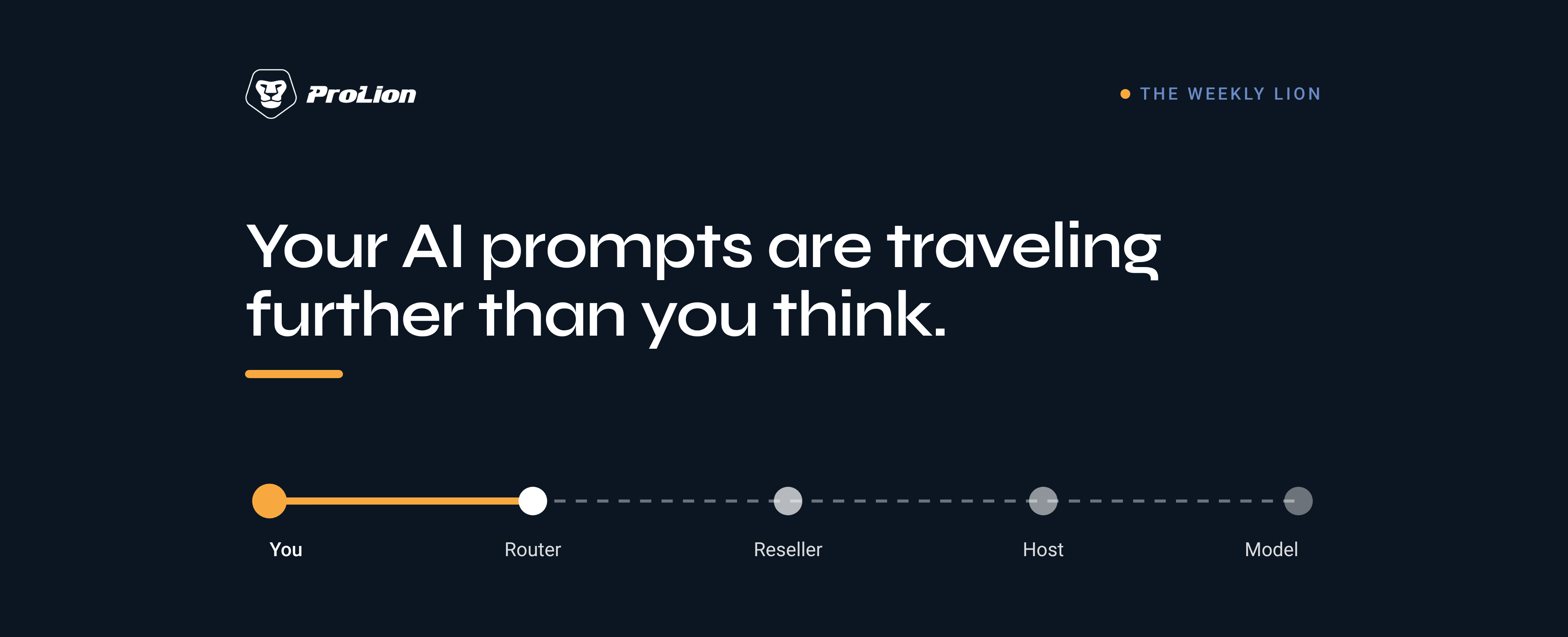
That data rarely takes a direct path. A single request can pass through several routers, resellers and hosting providers before it reaches a model, and every hop can see the full prompt. Dragos's own route tracing found undisclosed hops, unidentified systems and requests reaching companies that were never on the advertised path.
The most sobering conclusion: a privacy flag only binds the first hop. Contracts and settings matter, but they cannot protect data that has already left the building. And AI agents make the problem worse, because they will send whatever they can read.
For regulated organizations, a leak is also a compliance failure
For a hospital, bank, government agency or defense supplier, a leaked prompt is not just a security incident. It can be a regulatory one, too.
In the United States, healthcare organizations must control every party that handles protected health information under HIPAA. A prompt containing patient data that quietly passes through an unknown reseller breaks that chain. Public companies also face SEC rules that require timely disclosure of material cybersecurity incidents, including those that start at a vendor. And a customer who picked a U.S. provider to keep data in the U.S. may have unknowingly sent it abroad.
In the European Union, GDPR strictly limits transfers of personal data outside the EU unless strong safeguards are in place. Personal data that ends up with a lab in China, against the customer's own settings, is exactly the kind of transfer regulators scrutinize. NIS2 and DORA also hold critical-sector and financial organizations responsible for managing ICT supply chain risk. An AI supply chain you cannot see is a supply chain you cannot manage.
In every one of these regimes, the burden falls on the organization that owns the data, not on the vendor that lost it.
How ProLion helps: control the data before AI ever sees it
You cannot control every hop in someone else's AI supply chain. You can control what data is allowed to enter it. That is where ProLion focuses.
ProLion helps regulated organizations know, protect and control their file data on-prem and in air-gapped environments. Our platform runs entirely inside your perimeter, with no dependency on an outside cloud service, so securing your data never adds another hop. It connects quickly with an agentless approach that streams data events, giving you visibility without disrupting operations.
Applied to the risks Dragos uncovered, that means:
- Know what is sensitive before it reaches a prompt. ProLion discovers and classifies sensitive data, including personal, health, financial and regulated information, plus the credentials and secrets that attackers in this study went straight for. Classification is generally available today.
- Limit what people and AI agents can read. If an agent can read it, an agent can send it. ProLion shows who and what can access sensitive data and helps you tighten permissions, so a compromised account or an overeager AI tool cannot sweep up your crown jewels.
- Watch for data on the move. ProLion monitors data activity continuously and detects unusual access, mass reads and other signs that data is being staged to leave.
- Respond fast. When something goes wrong, ProLion helps you contain it, including blocking ransomware and malware at the point of write and supporting recovery after an attack.
- Prepare data for AI you run yourself. Dragos's top recommendation for the most sensitive work is to keep AI in-house. ProLion helps organizations make sure the data feeding on-prem AI is clean, compliant and under control, so they can trust their AI as much as they trust their own infrastructure.
Customers choose between two tiers. DataDefense focuses on protection and detection. DataGovernance adds the governance layer and broader connectors for compliance at scale.
Five steps for CISOs and AI leaders this quarter
None of this means you should stop using AI. It means where your data goes must be a deliberate decision. Start here:
- Map your AI paths. List every AI service, router and agent your teams use, and who actually processes each request.
- Classify before you connect. Know where sensitive data and secrets live before any AI tool or agent is given access to it.
- Apply least privilege to AI agents. Give agents access only to the data their task requires, and review those permissions like you would for a person.
- Seed your own canaries. Plant a fake credential in the data your agents and pipelines can reach, and treat any use of it as an incident.
- Keep your most sensitive AI work in-house. For regulated data, run AI on-prem or with a single first-tier provider under one contract, and avoid low-cost reseller marketplaces.
Trust your AI by controlling your data
The Dragos research is a wake-up call, not a reason to retreat from AI. The organizations that win in the AI era will be the ones that decide exactly what data their AI can touch, and where that data is allowed to go.
Our mission is to help the world's most regulated organizations know, protect and control their data, wherever it lives, so they can move confidently into the AI era. Data that never leaves your control cannot leak from someone else's supply chain.
Talk to ProLion about getting control of your sensitive data before your next AI rollout.