

Manufacturing is now the most targeted industry for ransomware, with attacks up 61% year-on-year.
The first weeks of 2026 have seen a wave of high-profile incidents on manufacturers around the world, including Magna Automotive Systems in Canada, Luxshare Precision Industry (a major Apple supplier) in China, and Wamtechnik (a battery and electronics manufacturer) in Poland.
This article breaks down why manufacturing has become the top target, what these attacks actually look like on the factory floor, and what security leaders in the sector need to prioritize right now.
Why Attackers Are Choosing Manufacturing
Threat actors know that manufacturing downtime hurts immediately. Production stops, orders stall, customers escalate, and the financial pressure starts building within hours.
“Operational downtime translates directly into financial pressure,” explains Trevor Horwitz, CISO and co-founder of TrustNet. “Unlike some industries where systems can degrade gracefully, manufacturing environments often cannot tolerate prolonged outages without halting production.”

The impact doesn’t stay contained either. Manufacturing is deeply connected to upstream and downstream businesses. Resources pile up waiting for processing, distributors miss out on the products they need, and even a small delay at one facility can ripple across an entire supply chain. Attackers know the pressure to pay the ransom is significant, and they set their prices accordingly.
How Attacks on Manufacturing Play Out
The typical sequence looks like this: an attacker gains initial access, often through a compromised credential or a phishing email. From there, they escalate privileges, map critical systems, and work their way toward domain admin. Once they have that level of access, they go after backup infrastructure, deleting restore points, tampering with recovery catalogues, and disabling scheduled backup jobs. Once they’ve weakened the organization’s ability to recover, deploy the payload.
In a manufacturing environment, the jump from “IT issue” to “production is down” can happen fast. Corporate IT systems and OT-adjacent services often fall over almost simultaneously.
Diego Matute, Founder and CEO of Cyphercor, has seen a facility shut down completely in under an hour from a single compromised remote access credential. “PLCs, SCADA systems, and HMIs that haven’t been equipped with security features can get caught in the middle of the attack very quickly,” he says. “And the difference is that you can’t simply restart a production line after restoring from backup.”

Timing is deliberate too. Attackers who have been inside the network for days or weeks can observe production cycles and delivery commitments.
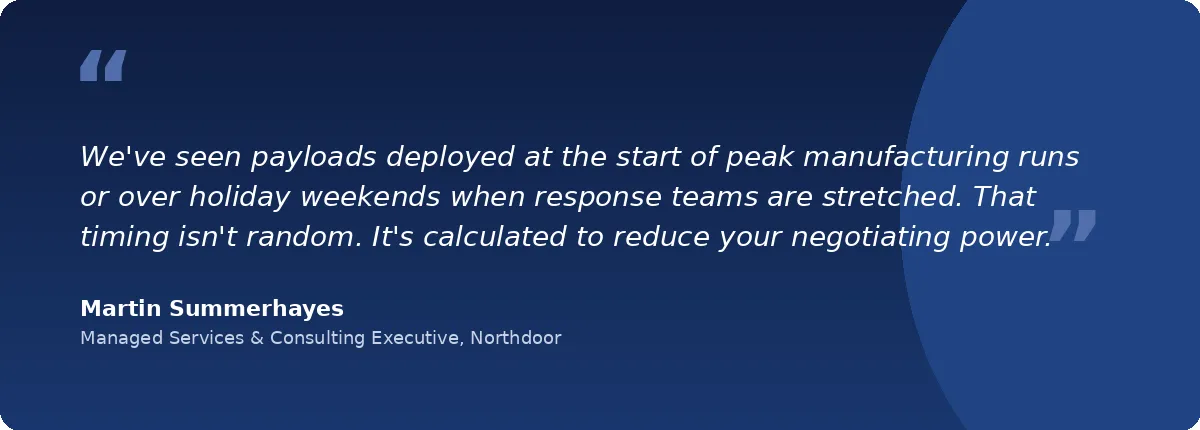
Martin Summerhayes, a managed services and consulting executive at Northdoor, has seen payloads deployed at the start of peak manufacturing runs or over holiday weekends, when response teams are stretched thin. That timing is calculated to reduce the organization’s negotiating power and maximize the pressure to pay.
Manufacturing’s Attack Surface is Growing
As factories modernize, the attack surface is expanding faster than security architecture can keep up. Industrial control systems, PLCs, and remote monitoring tools are now connected to enterprise networks, creating pathways between corporate IT and the production floor that didn’t exist a few years ago.
The problem isn’t digitization itself. It’s that many of these industrial systems were never designed to sit on interconnected networks. They were built to run for decades, and many of them do, on operating systems that are long out of support and can’t be easily patched. Once those systems are connected into corporate IT and that IT environment is breached, the blast radius increases quickly.
Recovery Is Harder Than You Think
Even organizations that have invested in backups and disaster recovery planning often find that their strategy doesn’t hold up under a real attack. Especially with attackers actively targeting recovery systems, the gap between what leadership believes is in place and what’s operationally true is where most of the risk sits.
Martin describes one incident involving a mid-sized manufacturer that believed it was reasonably well protected. They had backups, endpoint controls, and some segmentation. But attackers gained domain admin, removed recent restore points, and damaged the backup catalogue before deploying ransomware. Older tape backups existed, but rebuilding from them was slow and manual. Production was severely disrupted for an extended period.
“They technically had backups, but restoring cleanly wasn’t straightforward,” he says. “Systems had to be rebuilt manually. The impact went beyond lost production. It affected customers, supply chain commitments, and regulatory obligations.”

This is a common pattern. Organizations focus on the ransom number because it’s visible, but the bigger variable is recovery time. And that recovery time is rarely modelled realistically until after an incident. Downtime cost, customer impact, regulatory exposure: these tend to be abstract figures in a risk register until the factory floor actually goes dark.
Making things worse, many backup environments share the same identity systems and network controls as production. If an attacker compromises Active Directory, they often have access to the backup infrastructure as well. As Martin puts it: “If an attacker gains full control of Active Directory, they should not automatically be able to delete or corrupt recovery points. That requires architectural separation and strict privilege management, not just documented policy.”
What Manufacturing Leaders Need to Do Now
Manufacturing’s ransomware problem isn’t going to solve itself, but the path forward is clear. It comes down to closing the gaps that attackers are already exploiting: identity, access, visibility, and recovery.
Start with the basics. Diego Matute, Founder and CEO of Cyphercor, makes a simple but often overlooked point: implement MFA across the board. Not just corporate email, but remote access, OT interfaces, vendor accounts, and any system connected to the production floor. “In most cases, ransomware actors aren’t gaining access through zero-days,” he says. “They’re taking advantage of doors that were left open.”
From there, the priorities are architectural. Segment IT and OT environments so that a compromised corporate network doesn’t automatically give attackers a path to the production floor. Design recovery so it works even after a full domain compromise. And stop assuming OT is air-gapped, because in most modern environments, it isn’t.
Above all, organizations need real-time visibility into what’s happening at the storage layer. If attackers are spending weeks inside your environment before deploying ransomware, the only way to catch them is by monitoring data access as it happens. ProLion’s DataDefense does exactly this: it monitors all data access to storage systems in real time, detects anomalies like suspicious file extension changes or abnormal access patterns, and automatically blocks the threat before it spreads. When damage does occur, granular file-level visibility means teams can pinpoint exactly which files were affected and restore only those, rather than facing a slow, painful system-wide rebuild.
Want to see how DataDefense works? Watch the demo and see firsthand how proactive ransomware protection can safeguard your organization’s data, or check out our free guide to ransomware protection for security professionals.