


Ransomware attacks can be devastating, with each incident disrupting operations for weeks or months, and costing millions of dollars.
As attacks become more sophisticated, understanding how ransomware gets in and how to prevent it is essential. Read on to discover the most common attack vectors and learn proactive strategies to identify and block ransomware.
What Is Ransomware Prevention, and Why Is It Important?
Ransomware prevention is the practice of defending against ransomware attacks before they can encrypt your organization’s data and disrupt business operations.
Effective ransomware prevention means you can identify and respond to threats quickly without paying the ransom. The average ransom demand is $5.2M, but that’s just the tip of the iceberg. Businesses also face significant downtime, and many other issues, such as:
- Cost of recovery
- Disruption in customer services
- Damage to a company’s reputation
- Higher insurance premiums
- Compliance issues and legal fines
Ultimately, ransomware prevention is not just about avoiding financial loss. It’s about ensuring business continuity, maintaining customer trust, and staying on the right side of the law.
How Does Ransomware Get In?
To understand how to prevent ransomware, you first need to understand how threat actors target and attack organizations.
According to Sophos, malicious email and phishing now account for half of all incidents. Compromised credentials account for 23%, and exploited vulnerabilities for 18%. Taken together, four in five ransomware attacks now start with a compromised identity rather than a technical exploit.
Omair Manzoor, founder and CEO of offensive security firm ioSENTRIX, sees this pattern play out constantly in the red team engagements his company runs. He narrows it down to three main entry points: credential phishing (such as convincing fake login pages that harvest valid credentials), exploitation of internet-facing appliances like VPN concentrators, firewalls, and file transfer platforms, and compromised credentials bought outright from criminal marketplaces.
“What all three have in common is that the initial access looks legitimate,” Omair explains. “The attacker is using valid credentials through an authorized access path. This is why perimeter-focused defenses alone consistently fail against ransomware. The attacker does not break in. They log in.”
Best Practices for Ransomware Prevention
Here are some effective best practices and recommendations to prevent ransomware from successfully attacking your organization.
- Embrace defense in depth
Given the number of attack vectors, there is no magic silver bullet to protect you from all types of attacks. Instead, adopt a multi-layered cybersecurity strategy.
Mudita Khurana, a staff security engineer at Airbnb who leads security tooling across the software development lifecycle, says one of the biggest gaps she sees is that companies rely too heavily on one layer of protection, such as endpoint security, data backups, or network hardening. But expecting any one layer to cover the complete ransomware attack is unrealistic. “Organizations need defense in depth instead of one layer defenses, which means having a separate control available to stop or limit the attacker at each stage,” she says.

If an attacker still gets past the first layer, narrowly scoped permissions, separate administrator identities, and network segmentation are what stop them from expanding access from one compromised device to the rest of the network.
- Treat Identity as Your First Line of Defense
Given that four in five ransomware attacks now start with a compromised identity, this is where prevention efforts should concentrate first.
Omair’s recommendation is to deploy phishing-resistant MFA, meaning FIDO2 security keys or passkeys rather than push notifications or SMS codes, on every account with remote access or elevated privileges.
“If the attacker cannot use harvested credentials because authentication requires a physical key, the credential phishing pipeline breaks,” he says. This single control closes off the most common ransomware entry point identified in this year’s data.
- Implement a Zero Trust Security Model
Assume no entity or device is trusted by default, regardless of whether it is inside or outside the network. Zero trust requires verification at every step, significantly limiting the potential movement of ransomware within the network if an attack occurs.
- Restrict User Permissions
Limit user permissions to only those necessary for a user’s duties. This principle of least privilege can prevent ransomware from spreading to critical systems and limit the damage it can do. Learn more about how ProLion supports data access transparency, so you can track who has access to what.
- Carry Out Employee Training and Awareness Programs
Human error is a common entry point for ransomware attacks. Empowering your staff to recognize and report potential threats can dramatically reduce the risk of successful attacks.
Omair runs social engineering assessments as part of his firm’s red team work, and even in organizations with mature security awareness programs, his team achieves phishing success rates of 10 to 15%.
“In an organization of a thousand employees, we reliably compromise 100 to 150 credentials in a single campaign,” he says. “You only need one to get in.”
Where training provides the most value, in Omair’s view, is reporting culture. An employee who clicks a phishing link but reports it immediately gives the security team a chance to investigate.
- Don’t rely on backups alone
A common misconception is that backups will protect you from ransomware. Today’s hackers use double and triple extortion techniques. That means they don’t just encrypt your data, but they will also threaten to publish the data on the dark web if you don’t pay them millions.
Even if you can restore your data, the reputational damage, legal issues, and loss of customer trust can be devastating.
David Silva, Founder and CEO of CyberX, an ethical hacking company, explains, “Backups help you recover from ransomware, they do not prevent ransomware. They also do nothing to stop data theft. A company could restore every server successfully and still face a serious breach because customer records, intellectual property or confidential documents were stolen.”
David also strongly recommends testing the restore process: “You do not want to discover during a ransomware incident that the backup exists but cannot actually be restored.”
- Assume breach and prioritize early detection
Security teams are often focused on keeping attackers out (such as firewalls, email security, endpoint protection), and forget about what happens once a threat actor gets past those initial defenses.
Given the sophistication of attacks nowadays, it’s more effective to admit that a breach is likely and worth preparing for. This is known as an assume breach mindset, where the focus is on fast detection and response rather than assuming initial defenses will hold up.
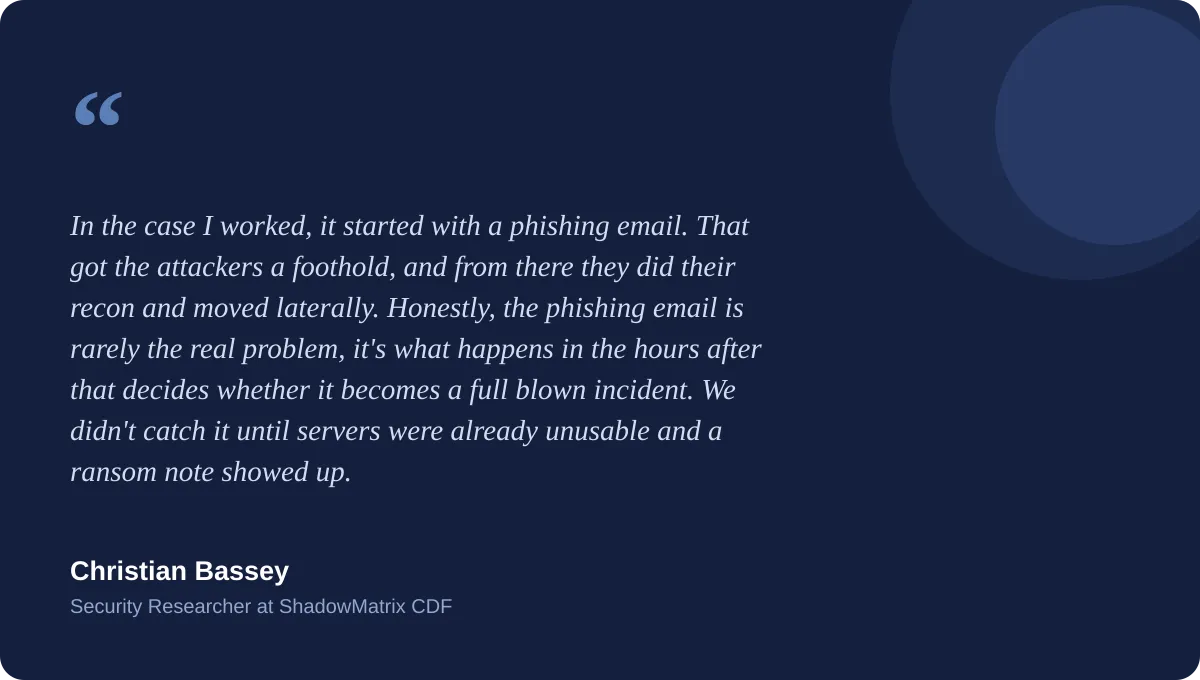
Christian Bassey, a security researcher at ShadowMatrix CDF and former Security Architect and Delivery Lead at Accenture, saw firsthand with a manufacturing company how important fast detection is. The attackers obtained a foothold via a phishing email and moved laterally through the network. “We didn’t catch it until servers were already unusable and a ransom note showed up.”
“If we’d picked up on the earlier signs, we could have contained it before a single file got encrypted,” says Christian. “That’s really the whole game with ransomware, catching the defense evasion and lateral movement stage instead of waiting for the payload to show itself.”
That’s where threat monitoring and detection tools come in. They can spot suspicious behavior, such as sudden mass encryption of files, and prevent it from spreading. DataDefense from ProLion monitors your network traffic and system activities and blocks suspicious users, stopping ransomware in its tracks.
Why ProLion Is the Most Effective Way to Prevent Ransomware
Despite your best efforts to train your staff and follow all the recommended security practices, the truth is, ransomware can still sneak through. That’s where ProLion steps in, acting as a last line of defense.
ProLion’s ransomware protection solution continuously monitors your storage systems, catching and stopping suspicious activities that hint at ransomware, like copying or deleting large amounts of files.
This kind of proactive defense ensures that even if some threats get past your initial defenses (like endpoint protection), they won’t get far.
Case Studies: How Organizations Prevent Ransomware with ProLion
Businesses around the world rely on ProLion to keep them safe from ransomware and other cyber threats.
With the increase in government attacks, the district of Tilburg, part of the Dutch government, decided to step up their ransomware prevention.
DataDefense protects the organization in two ways: via a blocklist and via behavior pattern monitoring.
The blocklist blocks all known ransomware extension types, while the monitoring tool tracks and logs user behavior. If it detects unusual activity, it immediately notifies the administrator and blocks the suspicious user.
As a result, the organization has been able to remain ransomware-free for many years.
It’s not just governments that need to prevent ransomware. There are many ransomware attacks in the healthcare sector, too.
The German hospital “Klinikum Peine” carries a huge responsibility for their patients and needs to keep confidential patient data safe. They rely on ProLion to keep them safe from ransomware. With real-time 24/7 monitoring of threat indicators, the hospital can avoid downtime and maintain patient care.
Next Steps: Prevent Ransomware Attacks Now
As ransomware attacks get more sophisticated, it’s crucial to be proactive and take action to bolster your defenses. Don’t wait for a breach!
There are a few things you can do right now to keep your organization safe from ransomware.
To learn more about the different ransomware prevention strategies, check out our beginner’s guide or (if you’re feeling up to it!) our expert guide.
If you already have some ransomware prevention strategies in place but you’re not sure how effective they are, take our cyber resilience assessment to find out.
And finally, sign up for a personalized live demo, where we’ll show you how our solution actively monitors and prevents ransomware in real-time. See for yourself how DataDefense detects and stops suspicious activities before they become a threat, keeping your business data safe and operations running smoothly.