Zero-days are a common ransomware attack vector, and because organizations aren’t aware of them, they are notoriously hard to prepare for. After all, how do you fix a vulnerability if you don’t know it exists? This lack of preparation is like catnip for threat actors.
Google’s Threat Intelligence Group tracked 90 zero-day vulnerabilities actively exploited in the wild in 2025. Nine of those were linked to financially motivated threat groups, and two led directly to ransomware attacks.
Here is what a zero-day actually changes about ransomware risk, how attackers turn one into an extortion event, and what a company can realistically do to prepare for a threat it cannot see coming.
What’s the Difference Between a Zero-Day Vulnerability and a Regular Flaw?
A regular vulnerability is one the vendor already knows about, whereas a zero-day is different because attackers find it first.
“A regular flaw is a known weakness,” explains Bryan Lopez, a cybersecurity expert and senior director at Microsoft. “The vendor has issued a patch, and the risk from that point forward is really about patch lag, not discovery. A zero-day is the opposite: it’s a flaw the vendor doesn’t know exists yet, which means there are, by definition, zero days of patch-based defense available. That’s the whole danger: it strips away the layer of protection most organizations lean on most heavily, which is ‘patch fast and you’re covered.'”
Why Are Zero-Days Such a Popular Entry Point for Ransomware Gangs?
Ransomware gangs love zero-day vulnerabilities, and the appeal comes down to economics and reliability.
Omair Manzoor, founder and CEO of security firm ioSENTRIX, notes that ransomware is fundamentally a numbers game that depends on getting inside a target environment at scale. Known vulnerabilities force attackers into a race against patching, but a zero-day eliminates the race entirely.
“There is no patch to race against,” he says. Well-funded ransomware operations can afford to purchase or develop zero-day exploits outright, because the return on a single successful deployment, often millions of dollars, easily justifies the acquisition cost.
Bryan points to a second factor: where these vulnerabilities tend to cluster. “Zero-days also tend to cluster in edge-facing software, VPNs, file transfer appliances, remote management tools, that’s internet-exposed by design, so one exploit can open the door across thousands of organizations simultaneously.”
That combination of being undetectable and broadly deployed is exactly what makes zero days attractive to ransomware affiliates who need reliable, repeatable initial access at scale.
How Fast Does a Zero-Day Get Weaponized Into a Ransomware Attack?
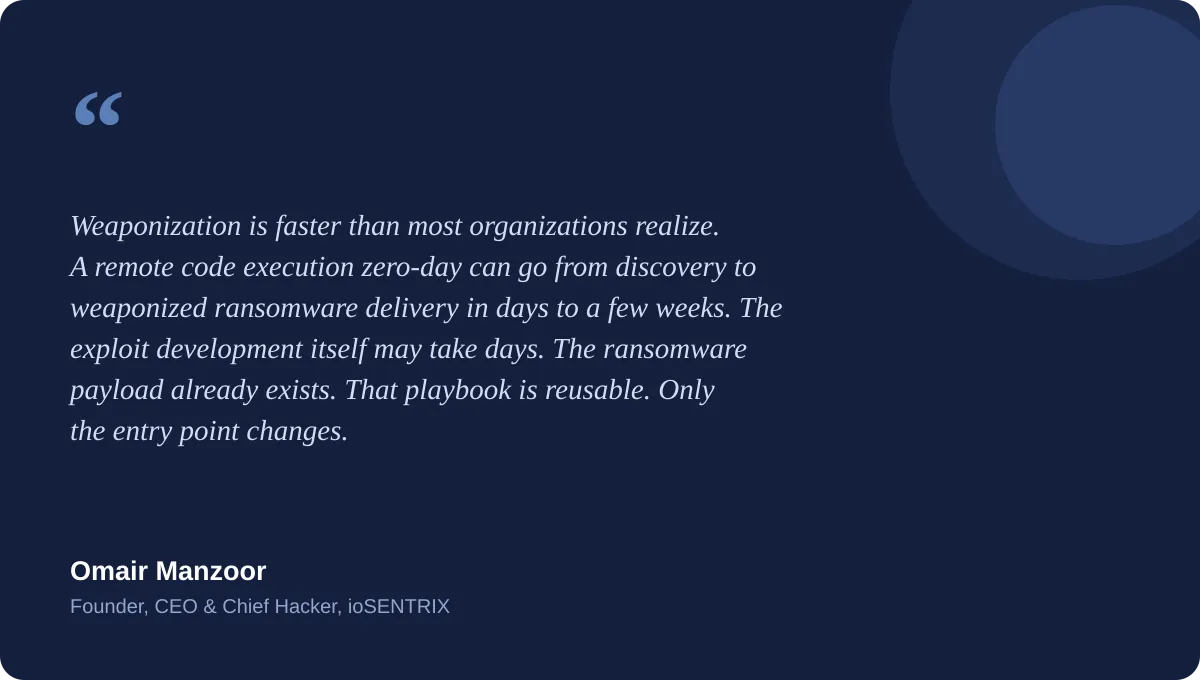
Threat actors find and leverage zero-day flaws faster than many organizations would assume. Timing depends on the type of flaw, but a zero-day in an internet-facing system like a VPN or firewall can go from discovery to a working ransomware attack in days to a few weeks. Part of why it moves so fast is that attackers usually don’t need to build anything new besides the exploit itself.
“The ransomware payload already exists,” says Omair. “They are plugging a new initial access vector into an established post-exploitation playbook: exploit, establish persistence, enumerate Active Directory, escalate privileges, disable backups, deploy ransomware. That playbook is reusable. Only the entry point changes.”
The specialized criminal ecosystem compresses the timeline further. An initial access broker may discover and exploit the zero-day, then sell that access to a ransomware operator who handles deployment. The division of labor means the time from vulnerability discovery to ransom demand keeps shrinking.
Examples of Zero-Day Ransomware Attacks
Here are two well-known examples of zero day incidents that turned into full-blown ransomware attacks.
MOVEit Transfer
In 2023, the Cl0p group discovered a SQL injection zero-day in the web interface of MOVEit, a managed file transfer platform used by thousands of organizations, including government agencies, financial institutions, and healthcare providers.
Because MOVEit exists specifically to move sensitive files, Cl0p didn’t need to move laterally through each victim’s network to find valuable data, it was already concentrated in the system they’d compromised.
Cl0p exfiltrated data and issued ransom demands over a single weekend, ultimately affecting more than 2,700 organizations, before the software vendor even knew the vulnerability existed.
SharePoint ToolShell
In 2025, attackers exploited a chain of vulnerabilities in internet-facing, on-premises Microsoft SharePoint servers to bypass authentication, remotely execute code, and upload a web shell. From there, they stole SharePoint’s MachineKey material, which let them maintain trusted access even after the original vulnerability was patched, extract credentials, move into other systems, and weaken Microsoft’s built-in protections.
The attackers altered Group Policy to distribute Warlock ransomware across the organization. By the time the ransomware was deployed, the attackers had already completed several stages of the intrusion.
Which Industries Are Vulnerable to Zero-Day Attacks?
The main targets for zero-day attacks are software companies with a large, homogenous install base, enterprise file transfer tools, VPN concentrators, remote management platforms, where a single zero-day scales like a supply chain attack.
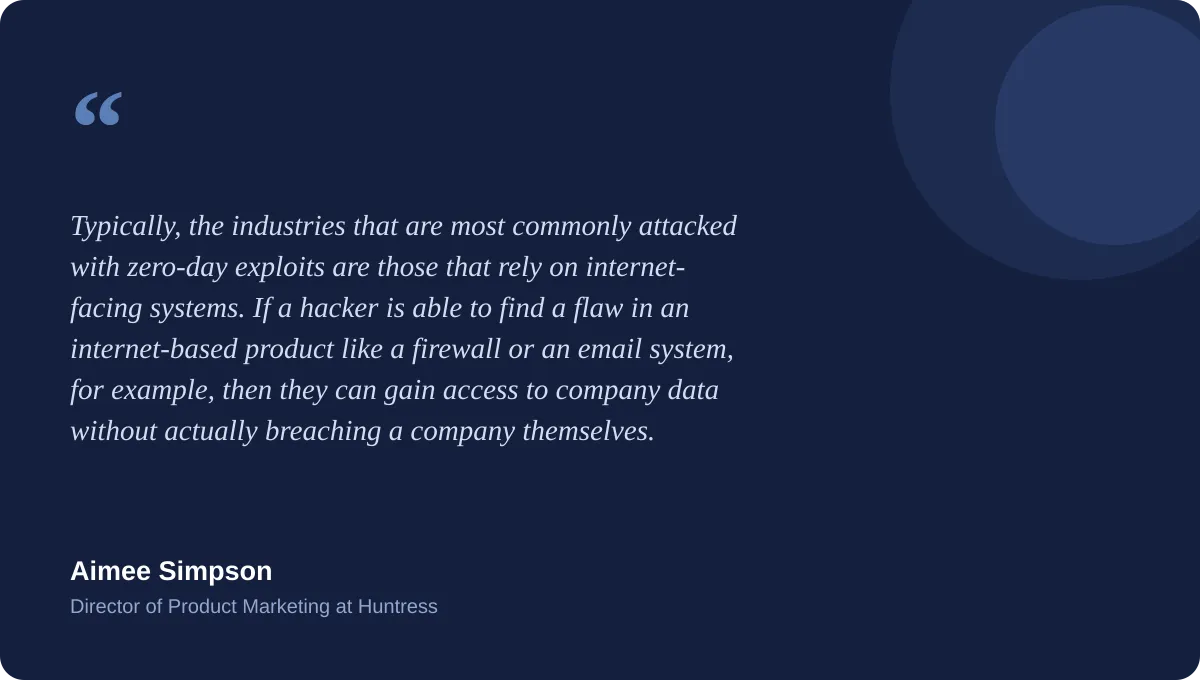
“Typically, the industries that are most commonly attacked with zero-day exploits are those that rely on internet-facing systems,” says Aimee Simpson, Director of Product Marketing at Huntress. “If a hacker is able to find a flaw in an internet-based product like a firewall or an email system, for example, then they can gain access to company data without actually breaching a company themselves.”
The second is sectors running legacy or operational technology and industrial control systems that can’t easily be patched or taken offline, such as healthcare, energy, and critical infrastructure in particular.
As Bryan puts it: “You can’t always patch a system that’s keeping something running in real time.”
Should Security Teams Just Assume a Zero-Day Will Get Through?
Treating zero day attacks as inevitable is a realistic approach. Many organizations run internet-facing software, a VPN concentrator, an email gateway, and file transfer platforms that almost certainly contain vulnerabilities nobody has found yet. A breach is likely, so it’s worth making sure you have a solid ransomware detection strategy in place rather than hoping prevention alone will be successful.
That’s the core of an assume-breach mindset. Rather than pouring resources into keeping every attacker out, a defense built around this assumption plans for what happens once someone already has.
Bryan puts it plainly: “The question is not whether a zero-day will be exploited in your environment. The question is whether your architecture limits the damage when it happens.”
How Can a Company Protect Itself Against Zero-Day Threats?
You cannot patch what you don’t know about, but you can architect your environment so a zero-day doesn’t automatically become a catastrophic breach. Five priorities matter most, roughly in this order:
- Identity and access controls: Ransomware operators will quickly escalate privileges and move laterally through your system after the initial breach. Be sure to follow Zero Trust best practices such as Principle of Least Privilege, so that one compromised account or device can’t access your entire network.
- Immutable, tested backups: Your ability to recover makes the difference between a small incident and a major breach. Ransomware operators deliberately target backup infrastructure, since they know a company with no backups will have no choice but to pay the ransom. Air-gapped, immutable backups that are regularly tested are a critical part of your defense strategy.
- Network segmentation: To contain the blast radius once a system is compromised.
- Behavioral detection: You need to be able to detect suspicious behavior such as privilege escalation, mass file operations, and backup deletion. This is what will enable you to quickly identify and contain the breach.
- Incident response plan: You need a clear checklist of what to do if and when an attack strikes. This will include disconnecting servers, informing key stakeholders, and liaising with law enforcement.
Why ProLion Is Built for This Kind of Threat
You cannot stop an exploit you’ve never seen. However, you can catch what happens immediately after: the lateral movement, the mass file operations, and the attempt to reach or disable backups.
When ransomware passes your initial perimeter, you need a last line of defense at the storage level. ProLion’s DataDefense identifies known ransomware signatures and continuously monitors storage systems for behavioral signals that indicate ransomware activity. It stops ransomware in its tracks by automatically blocking and reporting suspicious behavior.
Next Steps: Prepare for the Threat You Can’t Patch
You cannot eliminate zero-day risk. No organization can. What you can control is how much damage a zero-day is able to do once it’s inside.
To learn more about ransomware prevention strategies, check out our beginner’s guide or, for a deeper technical look, our expert guide. If you already have some prevention strategies in place but aren’t sure how they’d hold up in reality, take our cyber resilience assessment to find out.
And finally, sign up for a personalized live demo to see how DataDefense detects and stops suspicious activity in real time, whether it started with a known vulnerability or one nobody had ever seen before.