



Most organizations treat backups as their safety net, but ransomware operators have caught on. They know that an organization’s ability to recover is the one thing standing between them and a payout, so they’re making sure that option is off the table before they ever deploy a payload.
According to Veeam’s Ransomware Trends Report, attackers target backup repositories in 89% of attacks, and less than 10% of companies manage to recover more than 90% of their servers.
Here’s what security leaders need to know about how these attacks work, why traditional backup strategies are falling short, and what it takes to build real resilience.
Backup Targeting Is Now the Norm
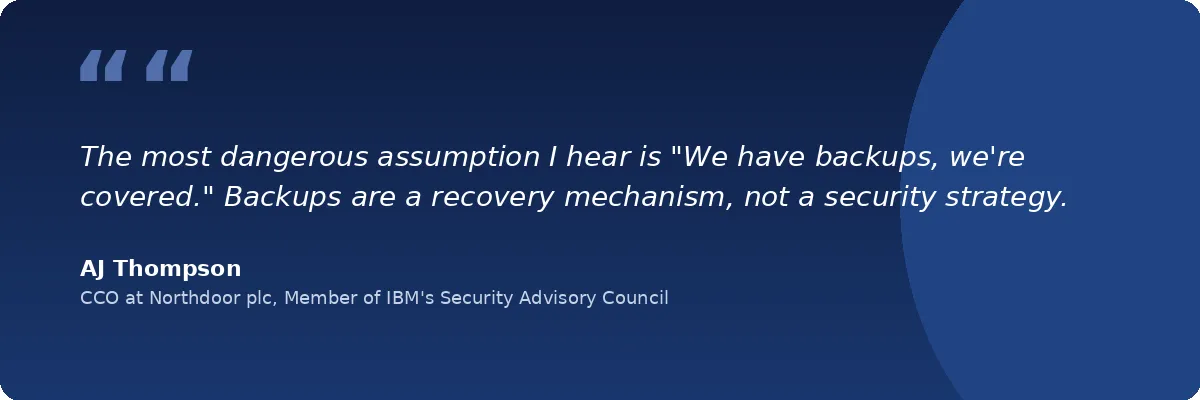
“Going after backups is no longer unusual. It’s standard practice,” says AJ Thompson, Chief Commercial Officer at the IT consultancy Northdoor plc and member of IBM’s Worldwide Security Advisory Council. “Attackers know exactly where organisations’ safety nets are. They go there first. The shift most organisations haven’t caught up with.”
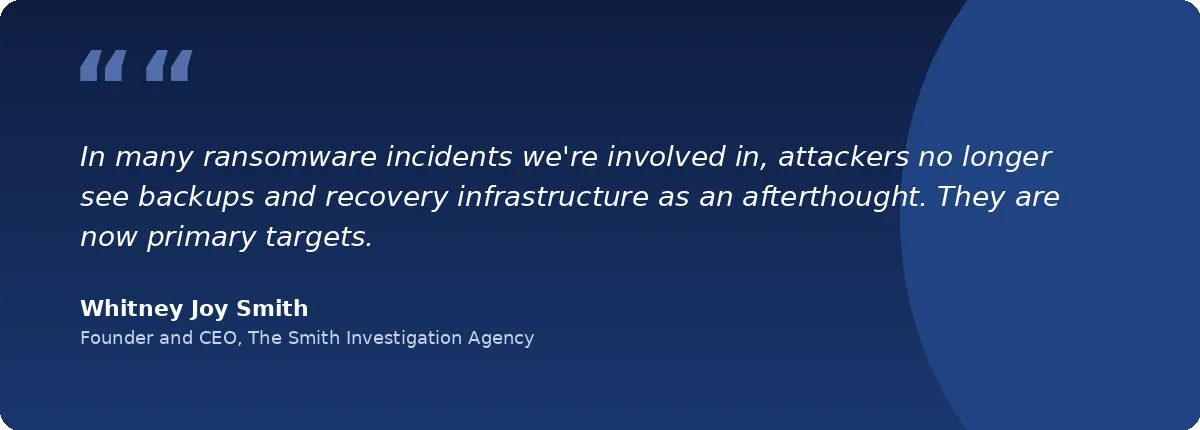
Whitney Joy Smith, Founder and CEO of The Smith Investigation Agency that investigates active ransomware attacks, sees the same thing. “In many ransomware incidents we’re involved in, attackers no longer see backups and recovery infrastructure as an afterthought. They are now primary targets,” she says. “Threat actors understand that the ability to restore data undermines their leverage, so they increasingly invest time early in the intrusion to identify, weaken, or eliminate recovery paths before deploying the ransomware itself.”
How Attackers Gain Access to Recovery Systems
Dismantling an organization’s backup infrastructure often isn’t technically difficult. Once attackers gain sufficient privileges, they tend to use the same tools the IT team relies on every day: management consoles, native admin utilities, and standard directory visibility.
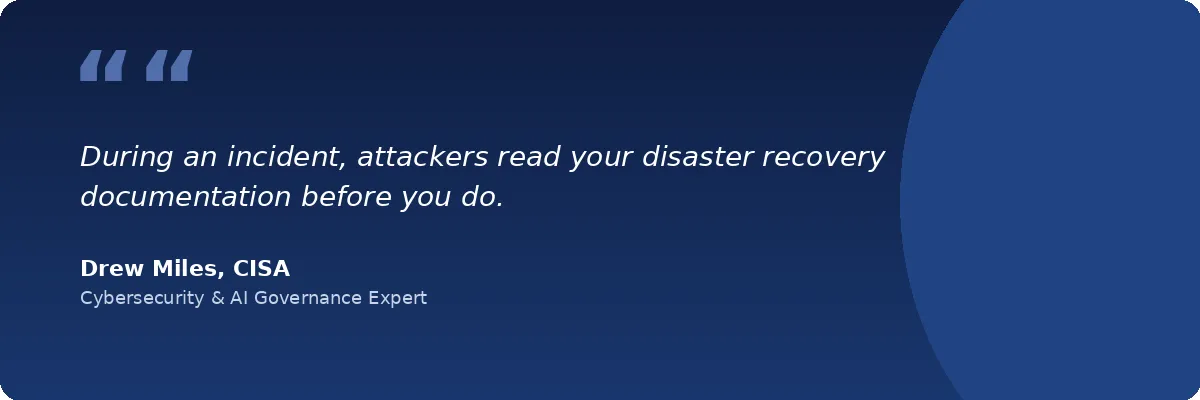
As Drew Miles, CISA and cybersecurity expert, puts it: “During an incident, attackers read your disaster recovery documentation before you do.”
Many recovery environments were never designed with an active adversary in mind, so locating backup servers, deleting shadow copies, or disabling scheduled jobs is surprisingly straightforward once someone has the right credentials.
It’s not uncommon for a threat actor to lurk in your system for weeks or even months. The attacker gains access, escalates privileges, and then uses that access to identify where backups are stored and what policies feed into them. Rather than striking immediately, they often disable auto-backup policies and then go quiet. Weeks, sometimes months later, the ransomware deploys.
When the team tries to restore, they’re looking at a copy that’s weeks old, if they have anything usable at all.
Even Functioning Backups Won’t Stop a Breach
There’s a bigger mindset shift happening here that many organizations haven’t caught up with. “We keep framing ransomware as an encryption problem,” says AJ. “Can you restore your systems? Will your backup hold? That’s the wrong question.”
Backups can restore systems, but they can’t recover stolen data. If client records, regulated information, or intellectual property have already left the building, getting your servers back online within 48 hours doesn’t change the fact that you’re dealing with a data breach.
Why Most Backup Strategies Fall Apart Under Pressure
Having backups is not the same as having a recovery plan. Oftentimes, backup tools get purchased, policies get configured, and everyone moves on. But the question of whether those backups can actually restore an environment under real-world attack conditions rarely gets tested.
Drew Miles, a cybersecurity and AI governance expert, calls this “the most dangerous assumption in cybersecurity” and sums it up well: “If a backup has never been fully restored under adversarial conditions, it is not a recovery plan. It is a wish.”
The gaps tend to be architectural:
- Backup admin consoles sitting in the same Active Directory domain as production systems
- Service accounts running backup agents with domain-joined credentials
- No immutability on storage targets
- No offline or air-gapped copies
- Retention policies that haven’t been reviewed in over a year
Each of these on its own is a manageable risk. Together, they mean that the moment an attacker compromises privileged credentials, the backup infrastructure is effectively within reach.
And it’s not just about whether backups exist. Recovery time objectives often turn out to be purely theoretical. Organizations assume they can restore within hours, but when critical data is missing, snapshots are corrupted, or offsite copies haven’t been verified in months, actual recovery timelines stretch into days or weeks. By that point, the pressure to pay the ransom is enormous.
AI Is Compressing the Timeline
The window for catching attackers before they do serious damage is getting smaller.
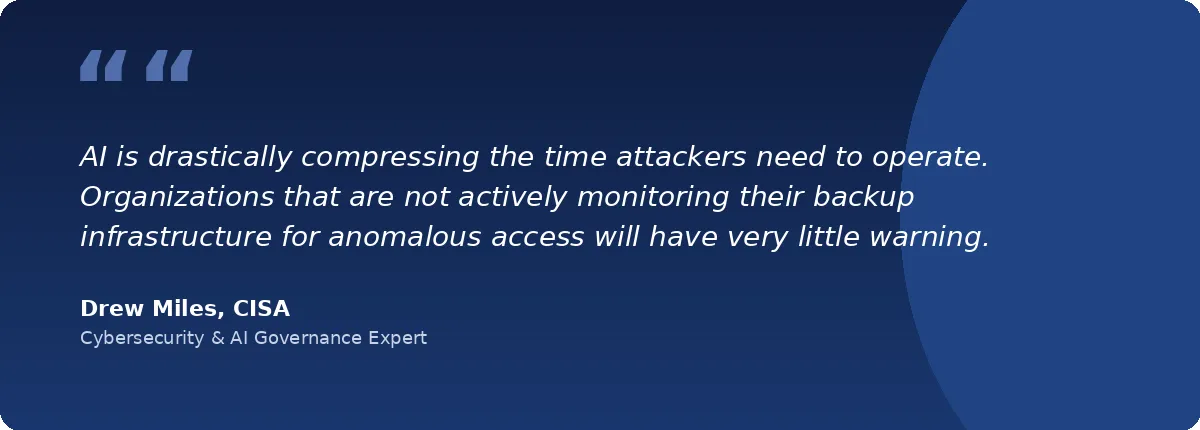
“AI is drastically compressing the time attackers need to operate,” explains Drew. “Previously, skilled operators spent days manually mapping a target’s backup infrastructure. Now that entire process can be automated and finished within hours.
According to Drew, the next evolution is adaptive payloads that modify their behavior based on the recovery infrastructure they detect, timing detonation to maximize the gap between the last clean backup and the moment the victim realizes they’ve been hit.
“Organizations that are not actively monitoring their backup infrastructure for anomalous access will have very little warning,” warns Drew.
How to Protect Your Systems and Backups from Ransomware
If attackers are going after backups first, the strategy needs to shift from recovery to detection. Organizations need visibility into what’s happening at the storage layer before ransomware detonates, not after.
That means monitoring data access in real time, isolating backup infrastructure from production identity systems, and actually testing recovery under realistic conditions. Backups aren’t useless, but they shouldn’t be your only line of defense.
ProLion DataDefense detects and blocks ransomware in real time by monitoring all data access to storage systems, identifying anomalies like unusual file extension changes or suspicious access patterns, and automatically neutralizing threats before they can encrypt your data or disrupt your business. When damage does occur, granular file-level visibility means teams can pinpoint exactly which files were affected and restore only those from snapshot, rather than performing a costly, time-consuming system-wide rollback.
Want to see how it works? Watch the demo and see firsthand how proactive ransomware protection can safeguard your organization’s data, or check out our free guide to ransomware protection for security professionals.